As an Amazon Associate, I earn from qualifying purchases. This post may contain affiliate links, which means I may earn a small commission at no extra cost to you.
Nothing says vacation mode quite like discovering your French Bulldog has a mysterious, rock-hard swollen leg right before you’re supposed to leave for the airport.
Seriously. The bags were packed. We were getting ready to get on a plane. I had time for one last snuggle with Electra before Zeus and Electra settled in with our trainer while we were away.
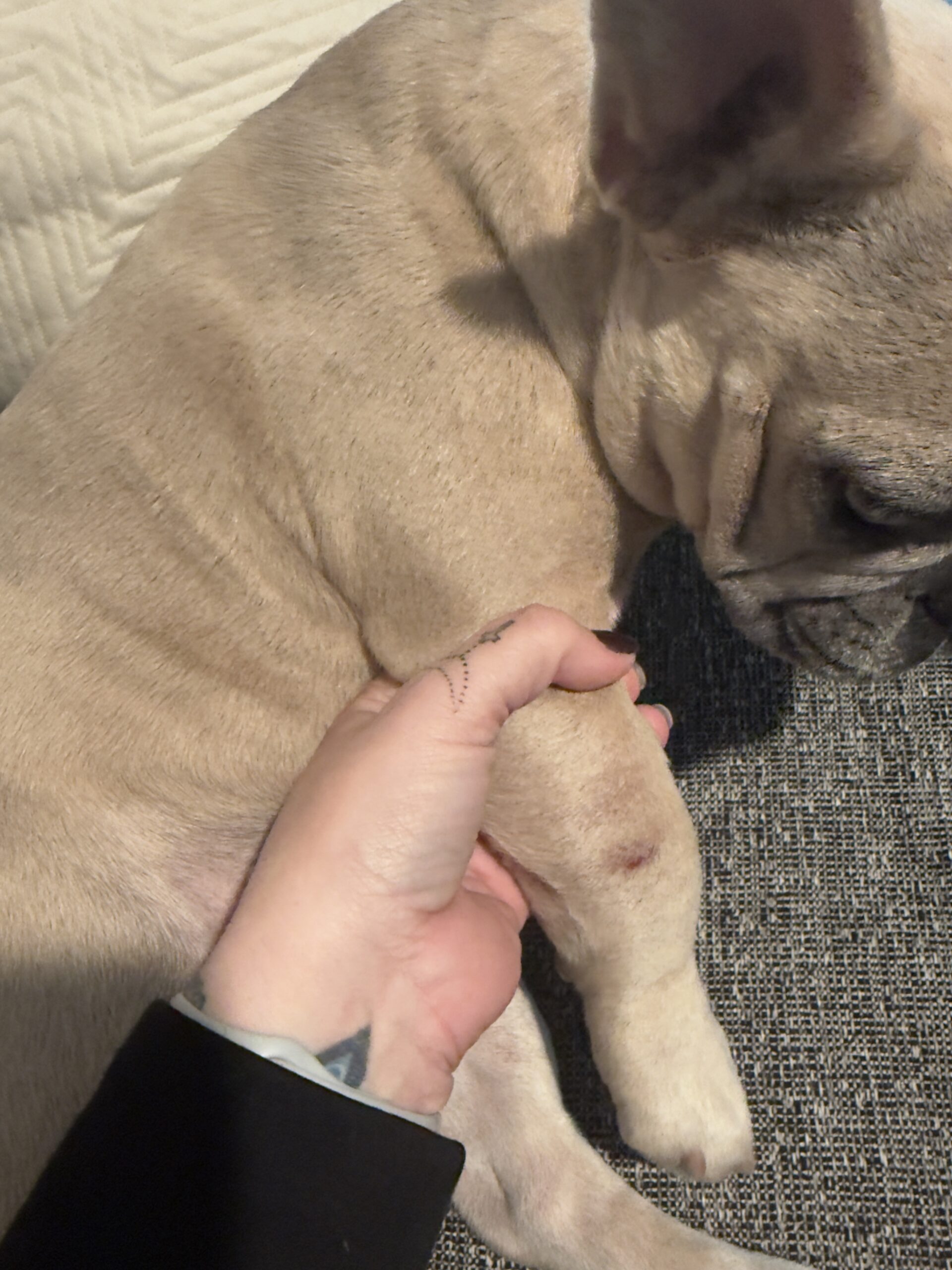
And then I felt her forearm.
Swollen. Hard. Definitely not normal.
That was me.
Within approximately three seconds, I had three thoughts:
- WHAT HAPPENED TO HER?!
- How much is this going to cost?
- ARE YOU KIDDING ME? WE’RE LEAVING FOR VACATION!
Electra, meanwhile, wasn’t even limping.
Which was reassuring, but also incredibly confusing. Because something had clearly happened to that leg.
And, naturally, it happened at possibly the worst time.
The Mystery Swelling on Electra’s Leg
The swelling was on Electra’s front leg, around her forearm. It felt unusually hard, and there were reddish marks on the skin.
One area had a small, darker spot that looked like it could have been a scab or tiny break in the skin.
It looked concerning enough that I knew we needed a veterinarian to take a look.
But here’s the strange part: Electra was still walking normally.
No obvious limp. No dramatic refusal to put weight on the leg. Just a very swollen forearm and absolutely no explanation for how it got that way.
Was it a spider?
Did she scratch herself on something?
Did Zeus accidentally get her during one of their play sessions?
We had no idea.
Trying to Get a Dog to the Vet While Also Trying to Catch a Plane
Thank goodness our dogs were staying with our trainer.
I called our veterinarian immediately and arranged for Electra to be evaluated. Then I coordinated with our trainer, who was able to take her to the appointment.
Trainer on the way.
Vet appointment secured.
Vacation departure rapidly approaching.

The second I got off the phone with the veterinarian, we had to leave.
I cannot tell you how strange it feels to head to the airport knowing your dog has a mystery injury and someone else is taking her to the vet.
On one hand, I was incredibly grateful that Electra was in capable hands.
On the other hand, I wanted to know what was happening with my dog!
Our trainer called us at the airport as soon as the appointment was over.
And the veterinarian’s conclusion?
Something got her.
Well, that certainly narrowed it down. 😂
Was It a Spider Bite, a Scratch, or Zeus?
The veterinarian couldn’t identify exactly what caused the swelling.
It could have been a spider bite.
It could have been a scratch.
It could have been another kind of bite, including something that happened while playing with Zeus.
There was no confirmed culprit.
What the veterinarian could tell was that the area looked infected and needed treatment.
Electra was prescribed antibiotics, and we were instructed to use warm compresses on her leg.
There was also one instruction I was particularly motivated to avoid needing:
If the swelling wasn’t improving within 24 hours, she needed to come back for a possible lancing procedure.
Oh, wonderful.
Nothing like imagining your dog needing a wound opened and cared for while you’re out of town.
We absolutely did not want Electra—or our trainer—to have to deal with that if it could be avoided.
Thankfully, things started moving in the right direction.
Thankfully, Electra Started Getting Better
The antibiotics appeared to do their job.
The swelling started going down fairly quickly, and the warm compresses seemed to help with her discomfort.
Best of all, she didn’t end up needing the lancing procedure.
By the time we returned from vacation, Electra was back to her usual self.
No mystery solved, unfortunately.
But one very relieved Frenchie mom.
And probably one equally relieved trainer.
But Could It Really Have Been a Spider Bite?
Once the immediate panic was over, I kept thinking about the spider possibility.
We live in the Pacific Northwest, where seeing spiders around the house is hardly unusual, especially during the time of year when they seem to make themselves more noticeable (which is NOW).
We’d also recently sprayed for spiders around our home.
So a spider bite was one possibility that crossed our minds.
But I want to be very clear about something:
We never saw a spider bite Electra. We never found a spider responsible for the injury. And our veterinarian did not diagnose a confirmed spider bite.
Her leg could just as easily have been injured another way.
Still, the experience made me curious.
What does a spider bite on a dog actually look like? What should you watch for? And what should you do if you think your dog has been bitten?
Here’s what I learned.
What Does a Spider Bite Look Like on a Dog?
According to veterinary resources, signs associated with spider bites can include:
- Redness or irritation around the affected area
- Localized swelling
- Pain or tenderness
- Warmth around the skin
- A small wound, scab, or other skin change
- Bruising or, with certain medically significant bites, more serious tissue damage
The tricky part?
None of those signs automatically means a spider was responsible.
Scratches, other animal bites, skin infections, and different injuries can look similar.

That’s why a suspicious-looking mark isn’t enough to identify a spider bite—and why I’m glad we didn’t try to diagnose Electra’s leg ourselves.
VCA Animal Hospitals explains that identifying the actual spider is the only way to definitively confirm which spider caused a bite.
Are Spider Bites Dangerous for Dogs?
They can be, but not every spider bite is a medical emergency.
Most spiders are not capable of causing serious venom-related problems in dogs. However, certain species—including widow spiders and recluse spiders—can cause significant illness.
A black widow bite, for example, may cause more than a small skin reaction. Affected pets can develop muscle pain, tremors, vomiting, and other symptoms.
Some recluse spider bites can cause local tissue injury that becomes more serious over time.
The important takeaway isn’t that every spider you see is a threat.
It’s that you can’t judge how serious a possible bite is from a tiny mark alone.
And in Electra’s case, the amount of swelling was reason enough for us to call the veterinarian.
Pet Poison Helpline’s spider information
What Should You Do if You Think a Spider Bit Your Dog?
After our experience, this is the approach I’d take if I found another suspicious swollen area on Zeus or Electra.
1. Check Your Dog, Not Just the Mark
Is your dog walking normally?
Are they acting like themselves?
Is the swelling getting bigger?
Are they showing signs of pain?
Electra wasn’t limping, which was reassuring, but it didn’t mean her leg was fine.
A dog can still need veterinary attention even when they’re putting weight on the affected leg.
2. Take Photos
This is one thing I’m glad we did.
Photos give you a record of how an area looked at a particular time, which can be helpful when you’re talking to your veterinarian or monitoring changes.
Try to photograph the affected area clearly, and take another picture later if your veterinarian asks you to track the swelling.
Just remember that photos don’t identify what caused an injury.
3. Call Your Veterinarian
If you notice substantial swelling, a suspicious wound, or signs of infection, don’t assume it’s a harmless bug bite.
Your veterinarian can assess whether your dog needs treatment, monitoring, or additional testing.
And if you suspect exposure to a medically significant spider, don’t wait for the situation to get worse before seeking advice.
4. Know When It’s an Emergency
Seek urgent veterinary care if your dog develops symptoms such as:
- Difficulty breathing
- Severe or rapidly spreading swelling, especially around the face or neck
- Collapse, marked weakness, or disorientation
- Muscle tremors or seizures
- Repeated vomiting or significant distress
- Severe pain or rapidly worsening skin changes
Those are not symptoms I’d want to monitor at home while hoping for the best.
5. Follow the Treatment Plan for Your Dog
This is an important distinction from Electra’s story.
Electra’s veterinarian specifically recommended antibiotics and warm compresses because of what they found during her examination.
That does not mean antibiotics or warm compresses are the right treatment for every possible spider bite.

For uncomplicated bite-related swelling, veterinary first-aid guidance may recommend a cool compress. Suspected infection, an abscess, or a more serious bite may need a different approach.
Don’t squeeze, puncture, or attempt to drain a swollen area yourself. And don’t give human pain relievers or other medications without veterinary guidance.
A Few Things I’d Keep Handy After This Experience
I’m not suggesting that every Frenchie owner needs an entire emergency room in their kitchen.
But having a few basics available can make an unexpected situation easier to manage.
A small pet first-aid kit: Useful for keeping basic supplies together, although it isn’t a substitute for veterinary care.
Clean, soft washcloths: Handy when your veterinarian recommends a compress, like ours did for Electra.
Your veterinarian’s contact information: Include the regular clinic and the nearest emergency clinic.
A plan for whoever watches your dogs: Our trainer being able to transport Electra to the vet was an absolute lifesaver.
Honestly, though, the most valuable thing we had that day wasn’t something we could order online.
It was a trainer we trusted who could step in when we couldn’t.
What Electra’s Mystery Leg Taught Me
I’ve learned plenty of things from living with Zeus and Electra.
Some lessons are funny.
Some are expensive.
And some happen approximately five minutes before you’re supposed to leave for vacation.
This one reminded me that you don’t always need to know exactly what caused an injury to know it deserves attention.
We still don’t know whether Electra encountered a spider, got scratched, or had a particularly enthusiastic play session with Zeus.
What we do know is that her leg was swollen, her veterinarian thought the area looked infected, and getting her evaluated promptly gave us a treatment plan and clear instructions about what to watch for.
Thankfully, she recovered without needing another procedure.
And we got to enjoy our vacation knowing she was being cared for.
Although, Electra?
Next time you have a mysterious medical situation, could we maybe schedule it for a day when we’re not heading to the airport?
Thanks, girl. 😂🐾
Disclaimer: This article shares our personal experience with Electra and general educational information about possible spider bites in dogs. Electra was never diagnosed with a confirmed spider bite. If your dog has unexplained swelling, a wound, or concerning symptoms, contact your veterinarian for advice specific to your pet.